

The disconnect between financial reports from ERP Systems and financial decision making
Organisations in the public sector mainly depend on their staff to achieve their service objectives. Hence resources should be allocated to develop the core skills of these staff to enable objectives to be achieved. This approach underpins HCM (Human Capital Management) strategies and forms a major part of developing and retaining staff who can assist in delivering the 3Es (Economy, Efficiency, Effectiveness). The ability to understand financial information and use if for decision making should be one of those core skills for anyone with financial responsibilities.
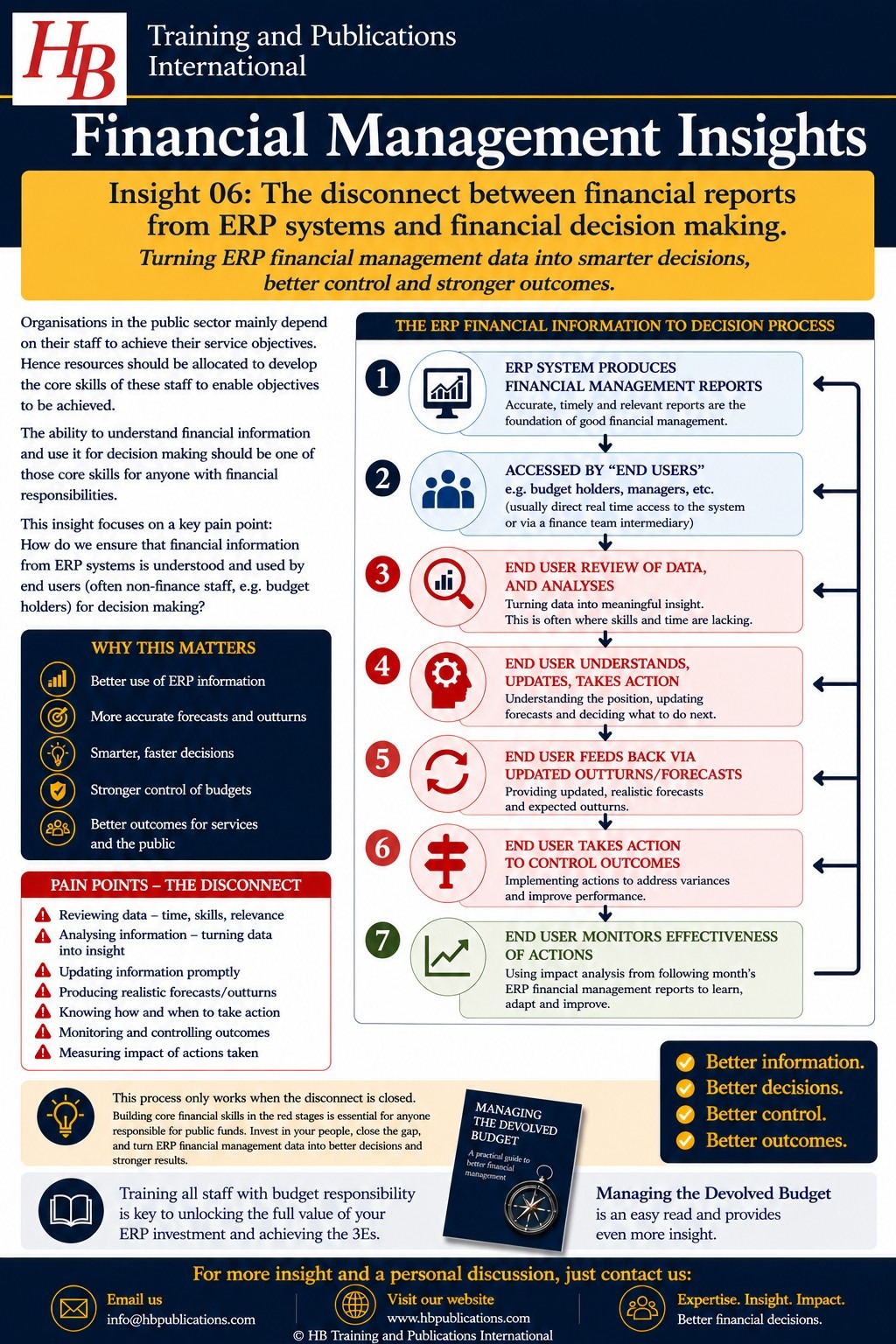
In this insight we focus on one of the key pain points of achieving positive ROIs on significant investments in ERP systems. How do we ensure that our ERP system financial management output information is understood and utilised by the end user for decision making. Where the end user is often a staff member without financial skills, e.g. a budget holder in a non-financial role. Set out below are the stages in the cycle, illustrated in the above image.
- ERP system produces financial management reports
- Accessed by end user, e.g. budget holders, managers, service heads, etc. (usually direct real time access to the system or via a finance team intermediary)
- End user review of data, and analyses
- End user understands, updates, takes action
- End user feeds back via updated outturns/forecasts
- End user takes action to control outcomes
- End user monitors effectiveness of actions with impact analysis from following month’s ERP financial management reports
The core skills development of staff is critical, and the temptation to cut these areas as part of a savings plan my prove counter-productive.
We are happy to share further insights or have a personal conversation, just contact info@hbpublications.com and/or visit our budget on track page, and consider providing support for budget holders.

