

Knowing the true cost of public services is essential to financial management
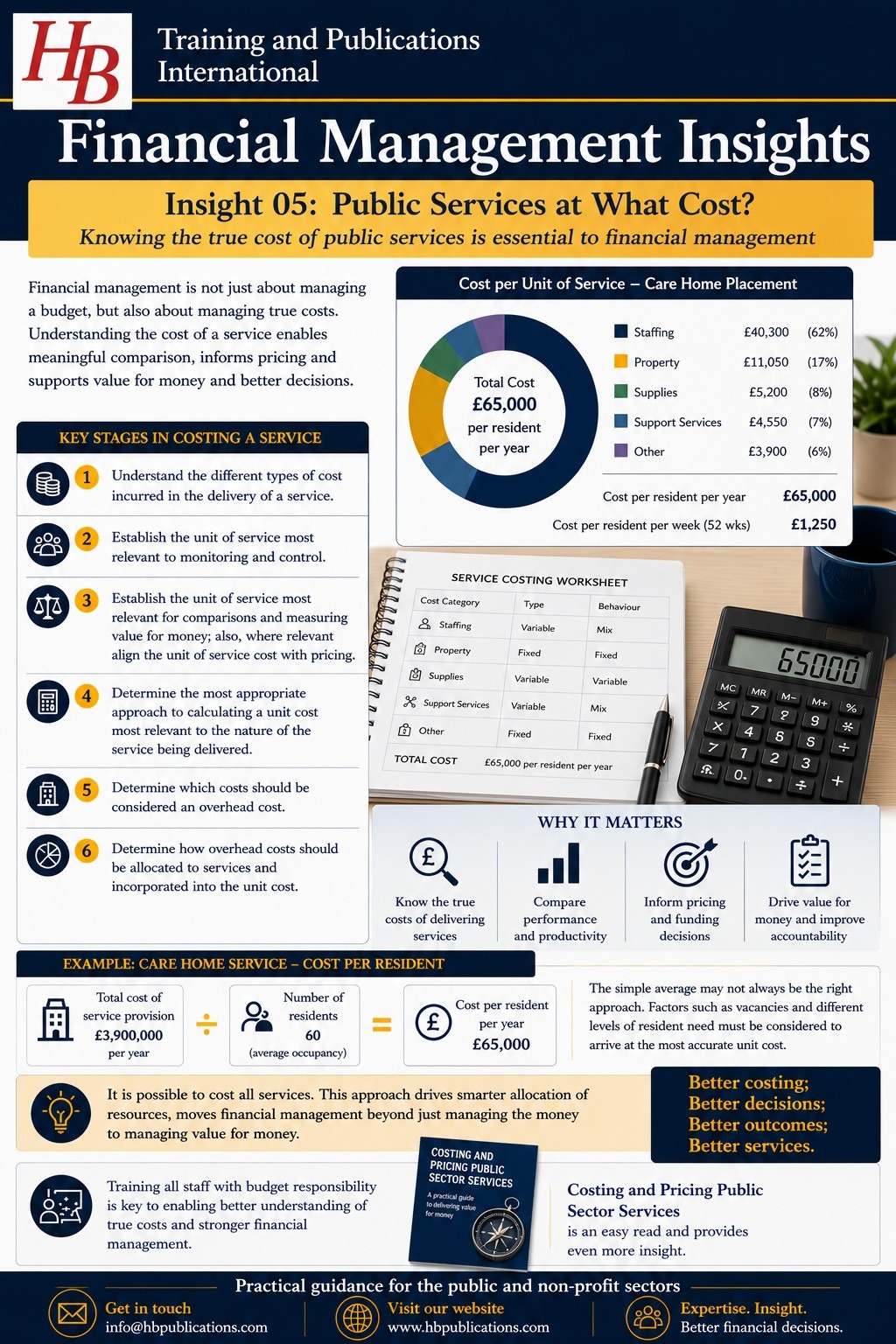
Financial management is not just about managing a budget, but also about managing true costs. Some services are easier to cost than others when the unit of service is clear cut, such as the cost of a placement. However, it is possible to attribute costs to all services related to productivity and output. It is only when such exercises are undertaken that true comparisons can be made and value for money established.
In this insight we identify the key stages that should be undertaken when establishing the cost of a service.
- Understand the different types of cost incurred in the delivery of a service
- Establish the unit of service most relevant to monitoring and control; comparisons and measuring value for money
- Align the unit of service cost with pricing where relevant
- Determine the most appropriate approach to calculating a unit cost most relevant to the nature of the service being delivered
- Determine which costs should be considered an overhead cost
- Determine how overhead costs should be allocated to services and incorporated into the unit cost
For example, providing care home services incurs a wide range of costs including property, equipment, staffing, supplies, maintenance, management, etc. These costs are different in type. Some are fixed, others variable, and some a combination of both. Within the definition of these, some costs can be controlled in the short term, whilst others are uncontrollable. The unit of service in this case is most likely cost per resident. This unit of cost can be compared in the market and can also be aligned with pricing (e.g. cost plus/minus). The most simplistic approach to calculating the unit cost per resident is to take the total cost of service provision and divide by number of residents that use the service. However, this may not be appropriate if there are vacancies; different levels of resident need etc. Some costing exercises can be complex. Overhead costs are always debatable as to their definition, content, and allocation.
The argument that it is not possible to cost certain services can be challenged If this approach is taken. It can drive the way financial resources are allocated, and financial management then moves away from just managing the money to managing the value for money.
Training all staff with budget responsibility is key to enabling smarter forecasting and more realistic outturns.
Costing and Pricing Public Sector Services is an easy read and provides even more insight.
#PublicSectorFinance #BudgetManagement #NonProfitFinance #FinancialLeadership #BudgetHolders

