

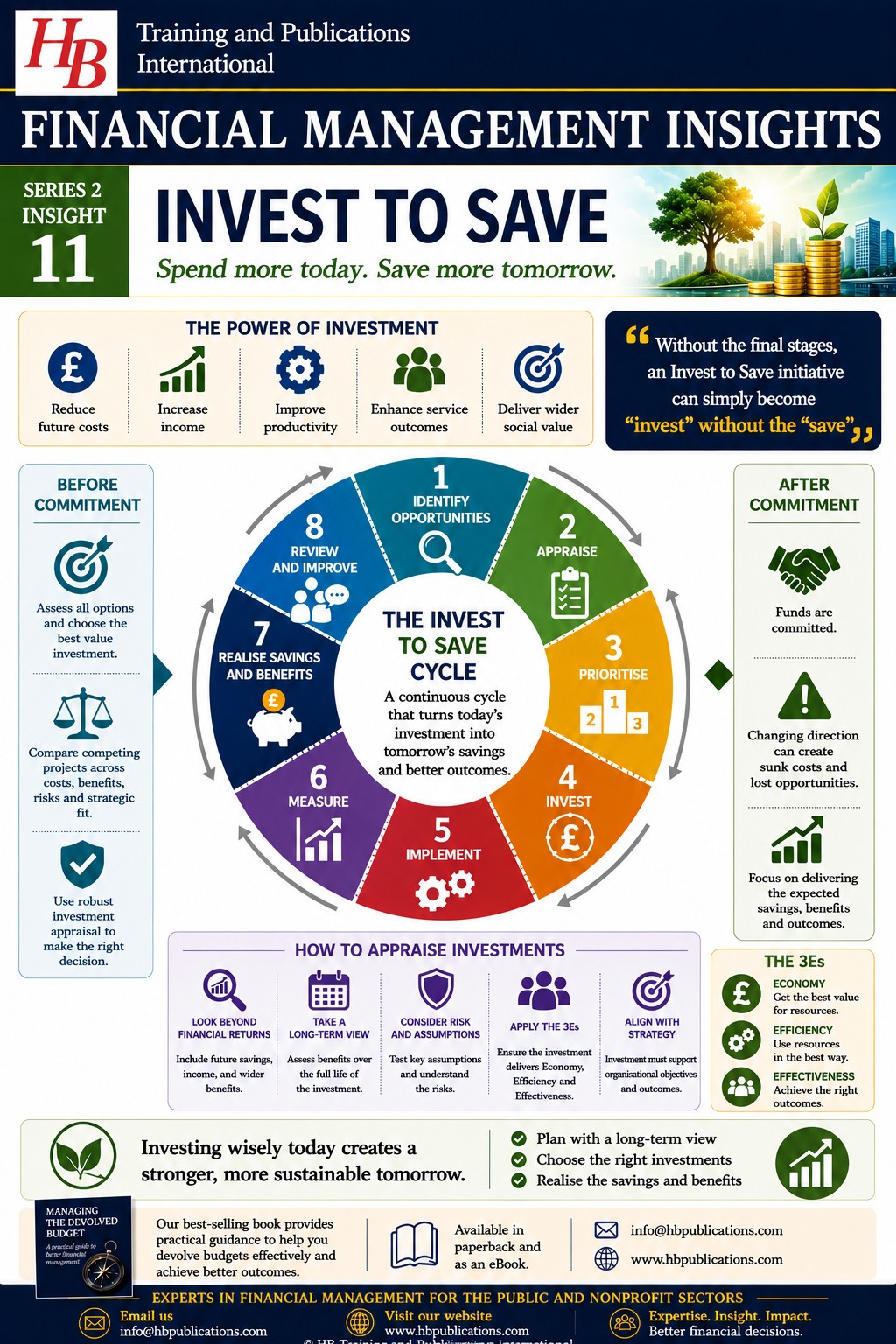
Sometimes spending more today is the best way to spend less tomorrow.
Public and non-profit organisations are frequently required to deliver more with limited resources. However, financial management should not simply be about reducing expenditure. There will be occasions when additional investment today can reduce costs, increase income, improve productivity or deliver better outcomes in the future.
This is the principle of Invest to Save.
Opportunities may arise through an organisation’s own resources or through external public and private investment. For example, central government may provide funding for house building, infrastructure, digital transformation, energy efficiency or service reform. Whatever the source, where funding is available for capital investment, organisations need to consider not simply whether they can spend the money, but where investment will generate the greatest value.
Investment decisions need a long-term view
Capital projects generally have consequences extending over several years. Decisions should therefore be considered within the organisation’s longer-term financial and strategic plans rather than simply against the budget for the current year.
This requires investment appraisal.
Traditional investment appraisal may consider the financial return generated by an investment. In the public and non-profit sectors, however, the return can be much broader. An investment may generate:
- direct financial savings;
- additional income;
- reduced operating costs;
- improved productivity and efficiency;
- avoidance of future expenditure;
- improved service outcomes; and
- wider social or community benefits.
A future saving can therefore be considered as an equivalent income stream when assessing the financial merits of an investment.
Compare competing investment opportunities
Resources are finite. Investing in one project may mean that another project cannot proceed.
Organisations therefore need a systematic method of comparing potential projects. This might consider:
Cost → Benefits → Savings → Outcomes → Risk → Timescale → Strategic fit
Financial measures such as payback periods, discounted cash flows and net present value can support the decision. However, these should not be considered in isolation. Public-sector investment decisions should also consider the 3Es – Economy, Efficiency and Effectiveness – together with the contribution the investment will make towards organisational objectives and outcomes.
A project producing the highest cash return is not necessarily the project producing the greatest public value.
The point of commitment matters
There is also an important distinction between planning an investment and committing to it.
Before commitment, alternative projects and approaches can be considered. Once contracts have been entered into and expenditure incurred, changing direction may create sunk costs – expenditure that cannot be recovered.
This makes rigorous appraisal particularly important before the point of commitment.
However, previous expenditure should not in itself justify continuing with a project that no longer represents value for money. Decisions should remain focused on the future costs, benefits and outcomes of continuing compared with the available alternatives.
From investment to savings
Approval of an Invest to Save project is only the beginning.
The anticipated benefits should be built into the financial plan and subsequently monitored. If an investment was approved because it was expected to save £500,000 over five years, the organisation needs to know whether those savings will actually materialise.
A strong Invest to Save approach therefore follows a continuous cycle:
Identify opportunity → Appraise → Prioritise → Invest → Implement → Measure → Realise savings and benefits → Review
Without the final stages, an Invest to Save initiative can simply become “invest” without the “save”.
The key questions
Before committing resources, decision-makers should be able to answer:
What are we investing?
What will it deliver?
What will it save?
When will the benefits arise?
How will we measure them?
What are the risks?
Is this the best use of the available resources?
Invest to Save is not simply about spending money in the hope of future benefits. It is about making evidence-based investment decisions that convert today’s resources into tomorrow’s savings, efficiencies and better outcomes.

