

Effective financial management, budgeting and control should underpin the operations of all public sector and nonprofit organisations. The reason being that they are responsible for public funds, and need to ensure value for money.
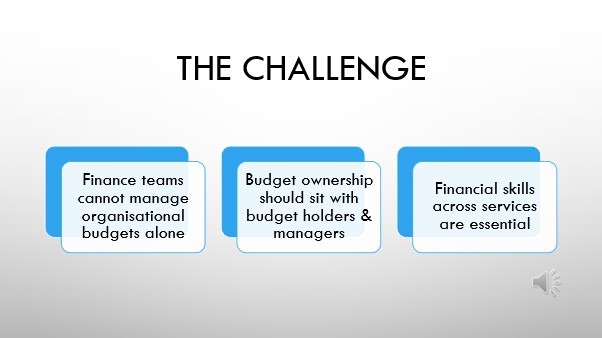
In the current environment public sector budgets are being challenged to deliver more for less. This requires all those tasked with spending public funds to take ownership of their budgets and be accountable for their use. Many budget holders are skilled professionals in specific disciplines but may not have any knowledge or experience in being responsible for a budget. This increases the challenges faced in ensuring public funds are managed and controlled.
Often training and development budgets face constraints which result in only “essential” training being funded and delivered. We consider that finance training should be in that category, but often it is not. There are many areas that we consider that anyone responsible for a budget at any level should be fully conversant with and form part of their underpinning knowledge.
| What Budget Holders Should know | Knowledge requirement |
| How to set a budget | Understanding budget drivers; costing and pricing; budget setting techniques such as incremental and zero based budgeting; organisational financial regulations such as authorisation levels and procurement rules; the budget setting timetable; etc. |
| How to monitor a budget | Undertaking variance analysis, projecting outturns, using service data to monitor costs (productivity) as well as budgets, understanding budget profiles, accessing financial reports, etc. |
| How to control a budget (budget management) | Taking action to correct variances; applying cash limits; using virements; using exception reporting; analysing service data; checking commitment levels; calculating value for money; matching budgets to output objectives; reforecasting; updating outturns to monitor impact; etc. |
| How to read and understand financial reports | Depending on the role, budget monitoring reports; financial accounts; expenditure reports; income reports; service provider contracts; etc. |
| How to work with finance teams | Understanding financial terminology; financial timetables for reporting; key financial assumptions for budget setting; designing financial reports to assist monitoring and control; making journal adjustments and virements; year-end accruals; etc. |
Although we refer to budget holders, we consider that anyone who has a role in spending money or raising money should have this knowledge, regardless of job title.
Our experience is that some staff are promoted to senior management positions without having this underpinning knowledge. Having not addressed the knowledge gap, earlier in their career, it becomes difficult to raise the issue as a learning need. This sometimes leads to an over-reliance on finance departments who cannot manage budgets without service input.
Learning Management Systems (LMS) offer a great opportunity to provide effective e-learning courses covering these areas. We offer a range of SCORM 1.2 compliant courses with standard modules which can be customised on request. These can be integrated with an inhouse LMS allowing access to all relevant staff. We have more information available in our 5 minute video on this link https://www.youtube.com/watch?v=EJtpp3cq2zY

