

Our first publication was Managing the Devolved Budget, and it remains our best seller. The concept of devolving budgets is not new. In fact, the debate about “Devolve or not to Devolve” has always, and continues to be, a topic of discussion. This insight considers the pros and cons of devolvement, the theoretical benefits and the practical challenges.
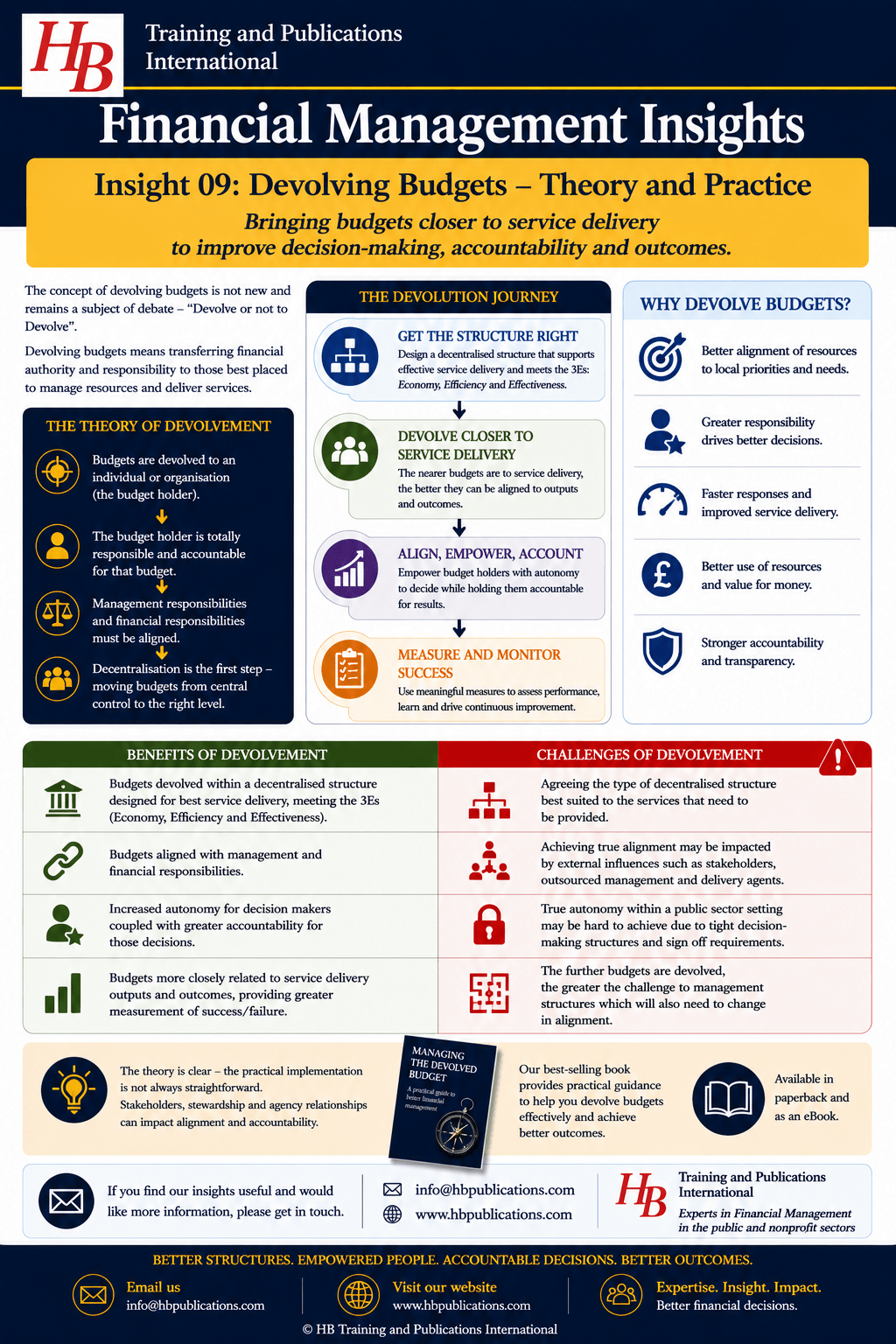
The theory of devolvement is the process whereby budgets are devolved to an individual or organisation who becomes the budget holder and who is then totally responsible and accountable for that budget. This requires management and financial responsibilities to be aligned such that the budget holder is accountable for the financial implications of their decision making.
The first step in this process is decentralisation, allowing centrally held budgets to be devolved within the decentralised structure. Getting the decentralised structure right is key to successful devolvement. This works at all levels within an organisation, within a service, within a department and within a team. The nearer budget devolvement is to service delivery, the more effectively budgets can be aligned to outputs and outcomes. This enables budget holders at whatever level to be held to account.
Whilst the theory is clear, the practicalities of implementation are not straightforward. The impact of stakeholders, stewardship and agency relationships can impact alignment and accountability. We set out below a brief table of benefits and challenges.
| Benefits of Devolvement | Challenges of Devolvement |
| Budgets devolved within a decentralised structure designed for best service delivery, meeting the 3Es | Agreeing the type of decentralised structure best suited to the services that need to be provided |
| Budgets aligned with management and financial responsibilities | Achieving true alignment may be impacted by external influences such as stakeholders, outsourced management and delivery agents |
| Increased autonomy for decision makers coupled with greater accountability for those decisions | True autonomy within a public sector setting may be hard to achieve due to tight decision-making structures and sign off requirements |
| Budgets more closely related to service delivery outputs and outcomes, providing greater measurement of success/failure. | The further budgets are devolved, the greater the challenge to management structures which will also need to change in alignment |
If you are finding our insights useful and wish to have more information, please get in touch at info@hbpublications.com or visit www.hbpublications.com
Our book – Managing the Devolved Budget – is available in paperback and as an eBook.
HB Training and Publications International: Experts in Financial Management in the public and nonprofit sectors

